 Engineering

CATIA, a leading solution in the field of 3D modeling and design, has once again raised the bar by integrating advanced artificial intelligence features. These AI-driven enhancements are transforming how designers and engineers work, making processes more efficient and intuitive.
In the latest release of 3DEXPERIENCE CATIA, Dassault Systèmes has introduced AI-driven features designed to eliminate repetitive tasks while preserving and respecting the original design intent. Features such as Command Intelligence, Mechanical Interface Prediction & Interference-based Connection Assistant, and Sketch Generative Constraints are demonstrated below to illustrate how they influence and enhance the design process by reducing manual intervention and significantly saving time.
Anticipating user-actions with Command Intelligence
Command Intelligence is a new introduction in 3DEXPERIENCE CATIA, AI-driven capability that anticipates the user’s next possible action. When a user selects a feature on a part or an item within the specification tree in 3DEXPERIENCE CATIA, the system analyses the selection and suggests the most relevant commands that can be applied to the selected object. This shows only possible commands.
Typically, users select the feature first, then find the appropriate command to be performed. This functionality eliminates the time spent searching for appropriate commands in toolbar, thereby improving workflow efficiency and reducing manual effort.
Command Intelligence tracks user behavior patterns by analyzing previously used commands, geometric context, and design intent and use this information to identify and present the most relevant next command, ensuring both productivity enhancement and preservation of design intent.
In above example after selecting the face on ‘Shaft’ it is showing other possible commands can be executed such as sketch, remove face, draft and shell.
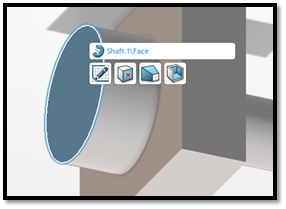
In the above example, after selecting the face on the 'Shaft', Command Intelligence displays follow-up commands to be executed, such as 'sketch', 'remove face', 'draft', and 'shell'.
Technical capabilities
- Contextual command suggestions
- Command recommendations are generated based on the currently selected feature, object, or geometry, and are further enhanced by incorporating historical user behavior to ensure relevance and efficiency.
- Geometry analysis
- The system performs an analysis of the local design conditions to determine which commands are most suitable for the current selection, ensuring context-aware and accurate suggestions.
- Learning mechanism
- The quality of command suggestions improves over time as the system continuously learns from user interactions and established design workflows, resulting in increasingly intelligent and personalized assistance.
Engineering impact
This feature displays corresponding command suggestions directly above the mouse cursor after a selection is made. Due to this, users can work seamlessly select and execute the desired operations in no time.
With these, designers can focus more on design logic and creativity rather than spending time searching for commands within toolbars. The feature can save up to 30% of routine modeling time, hence productivity and overall design output is increased.
Accelerating assembly design with AI-analysis of surfaces and parts
Assembly design is one of the most critical stages in the product development process, as this is where the product truly takes shape. A well-defined product structure from the start ensures high manufacturing quality and minimizes rework. To achieve accuracy in assembly design, mechanical constraints play a vital role. They help designers apply engineering connections by identifying functional surfaces, mating conditions, part interactions, and relative motions. However, this evolution of assembly typically occurs step by step, making it a manual and time-consuming task.
The latest update in 3DEXPERIENCE CATIA introduces the Mechanical Interface Prediction and Interference-based Connection Assistant, which significantly accelerates this process with enhanced accuracy. Powered by AI, these features analyze surfaces and parts, determining their kinematic relationships, and automatically generating interface-based connections followed by geometric constraints (engineering connections). Designers can then review the AI-generated list, select the applicable connections, and apply them effortlessly.
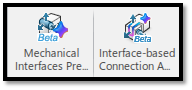
This innovation saves designers considerable time while improving precision and efficiency in assembly design.
Mechanical Interface Prediction
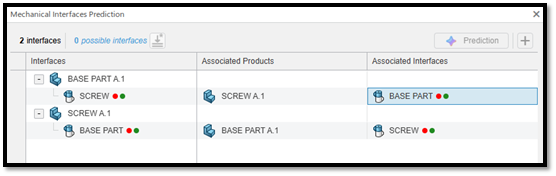
- Functional surface recognition
- The AI-assistant looks for 3D structure, and product surfaces likely to have mechanical connections.
- Interface proposal
- Once surfaces are identified for connections, applicable connection types are suggested (revolute, cylindrical, universal, rigid, etc.) based on geometry, function, and orientation of the parts in the assembly.
- Interfaces are shown with appropriate color code (primary surfaces in red, secondary surfaces in green, tertiary surfaces in blue, maintain surfaces in yellow, and shared surfaces in purple. This leads to reduced variability in assembly, ensuring appropriate connections are applied between parts.
Interface-based Connection Assistant
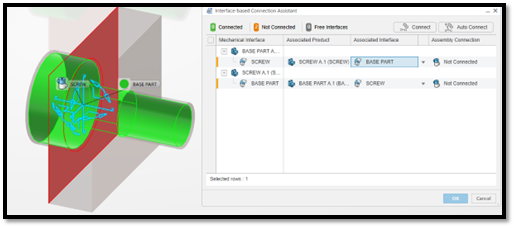
- Automated connection creation
- Based on created interfaces, applicable engineering connection can be created automatically.
- Color-coded interface status
- Color-coded geometry presentation in order to identify the correct object, i.e., which part is primary and which is secondary.
- Editing and reuse
- Interfaces and engineering connection can be edited very easily by double-clicking on operation in tree. Also, it can be reused in similar multiple instances.
Engineering impact
It reduces manual definition and validation time for creating connections. These tools significantly reduce the time for creating assembly while maintaining high accuracy. Designers can now detect interfaces issues associated to it sooner and reduce cost of rework.
AI-driven automation of design constraints
Sketching is a start point of any design. Sketch defines the very first object profile. Adding constraints to a drawn sketch is a tedious task. Sketch Generative Constraints in 3DEXPERIENCE CATIA is an AI-driven automation which solve this tedious task in one click.

Technical Capabilities
- ISO constrain
- This capability generates sketch constraints with respect to ISO guidelines without over constraining the sketch.
- Single-click constraint creation
- All required constraints created without manual selection in one click.
- High speed
- Faster processing of complex sketches to create constraints.
- Layout of dimensions
- Dimensions created are placed neatly as per ISO guidelines with this AI capability places.
Engineering impact
Automated constraint generation applies all necessary constraints in a single click, ensuring that sketches are neither under- nor over-constrained. Engineers can easily modify dimensions to achieve the required design intent. This significantly reduces design time while enabling high-quality designs to be completed more efficiently.
Context-driven user interfaces
3DEXPERIENCE CATIA can now automatically generate user interfaces that are tailored to specific tasks and workflows. This dynamic generation of UIs improves efficiency and ensures that users have access to the tools they need when they need them.
Structural generative design
- AI is utilized in industrial companies to speed up product design and automate processes.
- Knowledgeware in CATIA allows users to incorporate company-specific knowledge into product design, enhancing efficiency.
- Topology optimization in 3DEXPERIENCE CATIA uses AI to create lightweight, bionic shapes for parts, adaptable to various manufacturing processes.
Expert insight
Individually, each capability enhances a specific phase of the design process. Together, they form a cohesive, AI-driven design framework:
- Command Intelligence optimizes daily user interactions by anticipating the next best action.
- Mechanical Interface Prediction and the Connection Assistant automate and validate assembly logic.
- Sketch Generative Constraints applies fully compliant constraints to sketches in a single click.
- Context-driven user interfaces present users with the right tools at the right moment.
This enables engineers to move away from repetitive, manual operations and focus on higher-value engineering decisions. By embedding intelligence directly into modeling, sketching, and assembly workflows, AI acts as an active design partner.
The result?
- Faster time-to-market
- Reduced design cycles mean products reach customers quicker.
- Higher accuracy
- AI-driven validation slashes errors, minimizing costly reworks.
- More creativity
- With automation handling the repetitive tasks, designers are free to innovate, iterate, and push boundaries.