 Advanced Simulation

Introduction
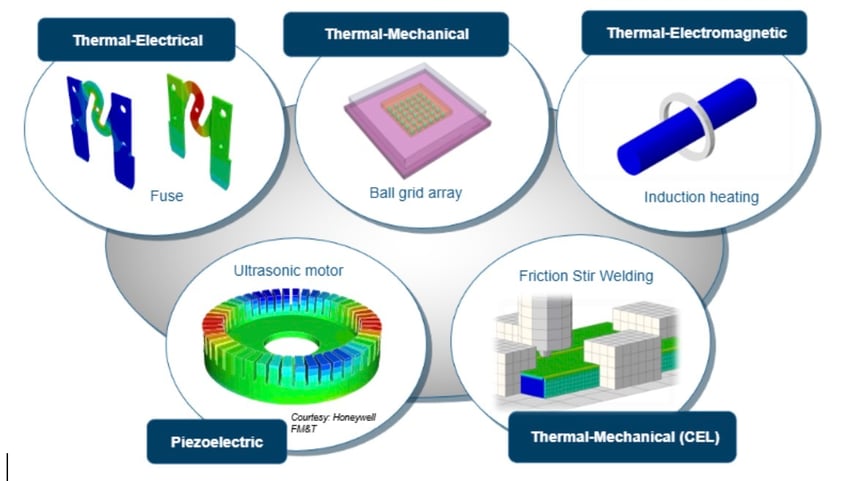
Abaqus started as a structural analysis software, but during nearly half a century of its development, its capabilities extended far beyond solid mechanics. Currently, Abaqus may also solve thermal, acoustic, mass diffusion, and electromagnetic problems, among others. However, it also includes many procedures dedicated to so-called multiphysics or coupled analyses where more than one branch of physics is involved.
Abaqus solvers are primarily divided into Abaqus/Standard (implicit general-purpose solver capable of solving static and dynamic problems and supporting a wide range of non-structural and coupled analyses) and Abaqus/Explicit (explicit dynamics solver always solving dynamic equilibrium, but also used in quasi-static simulations and offering some couplings with other types of physics as well).
Abaqus/Standard offers the following multiphysics analysis procedures:
- Thermal-mechanical (sequentially or fully coupled or adiabatic heating)
- Structural-acoustic
- Linear piezoelectric
- Thermal-electrical (Joule heating)
- Thermal-electrical-structural
- Thermal-electrochemical
- Thermal-electrochemical-structural
- Fully or partially saturated pore fluid flow-deformation
- Thermal-mechanical (fully coupled or adiabatic heating)
- Structural-acoustic
- Fluid-Structure Interaction (FSI) - coupling Abaqus/Standard or Abaqus/Explicit to a Computational Fluid Dynamics (CFD) software. Abaqus solves the structural domain, and the CFD software solves the fluid domain. Abaqus can be coupled with the SIMULIA Navier-Stokes solver (available in the Fluid Scenario Creation app on the 3DEXPERIENCE platform) or with various third-party CFD solvers.
- Conjugate Heat Transfer (CHT) - conjugate heat transfer problems involving fluids and structures can be solved by coupling Abaqus/Standard to a CFD software. Abaqus/Standard models heat transfer within the solid, and the CFD software solves the energy equation for the fluid flow surrounding the structure. Abaqus/Standard can be coupled with the SIMULIA Navier-Stokes solver (available in the Fluid Scenario Creation app on the 3DEXPERIENCE platform) or various third-party CFD solvers.
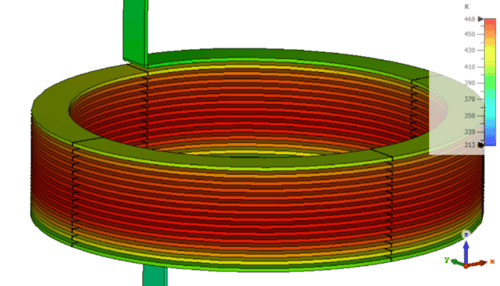
- Electromagnetic-thermal or electromagnetic-mechanical coupling - applications such as induction heating require interaction between electromagnetic and thermal fields. This can be achieved by coupling Abaqus/Standard with itself, where one analysis solves for the electromagnetic fields, while the other solves for the thermal fields. Alternatively, Abaqus/Standard can be coupled with CST Studio Suite or with various third-party electromagnetic solvers.
- System-level modeling via logical-physical interaction - modeling of systems that can include both physical (structural, thermal, acoustics, etc.) and logical components modeled via a Function Mock-up Unit (FMU) using the Functional Mock-up Interface (FMI).
Abaqus/Explicit supports the following multiphysics procedures:
- Thermal-mechanical (fully coupled or adiabatic heating)
- Structural-acoustic
Both these solvers may also be used for multiphysics couplings through SIMULIA Co-Simulation Services (CSS).
Thermal-mechanical analyses
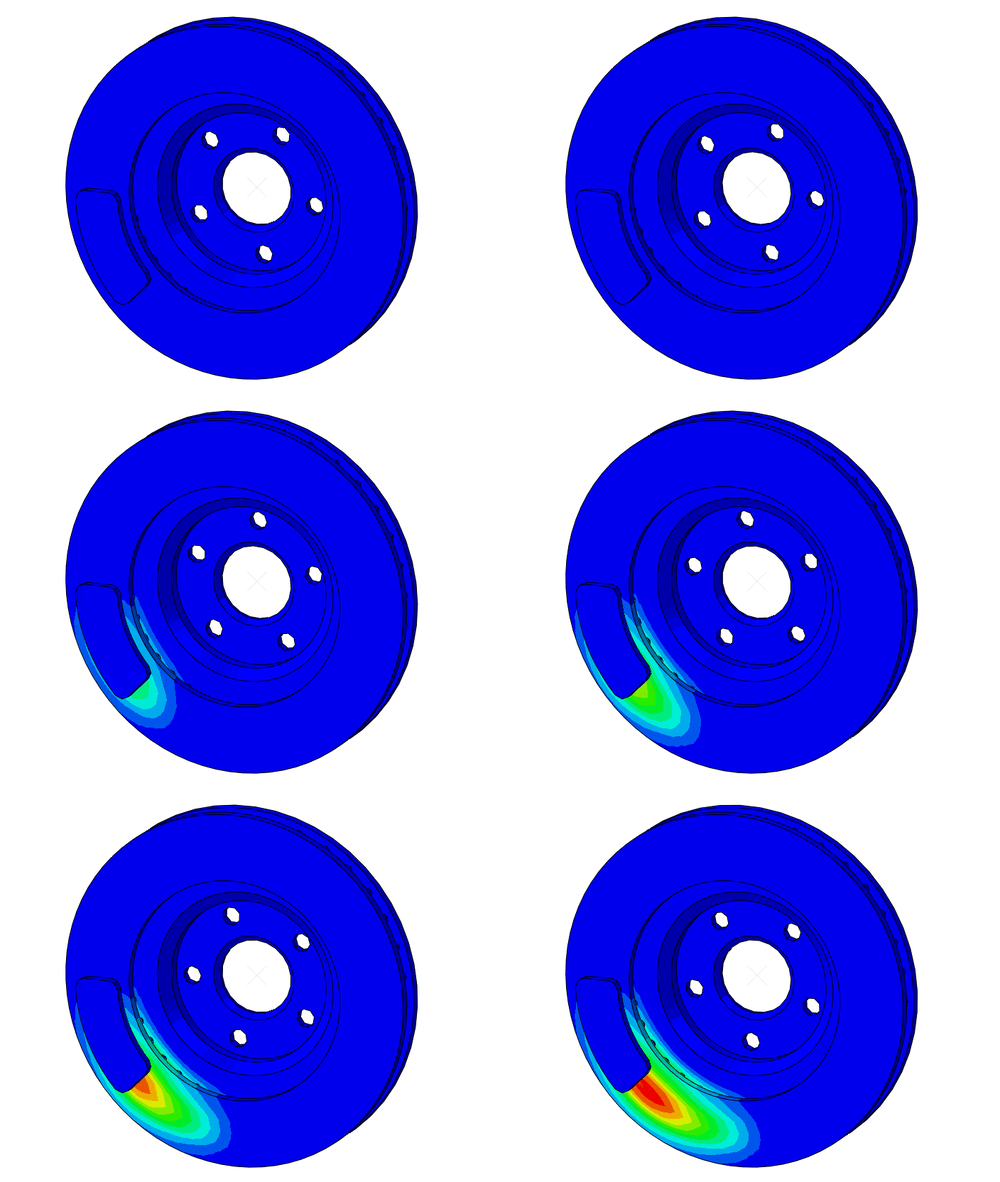
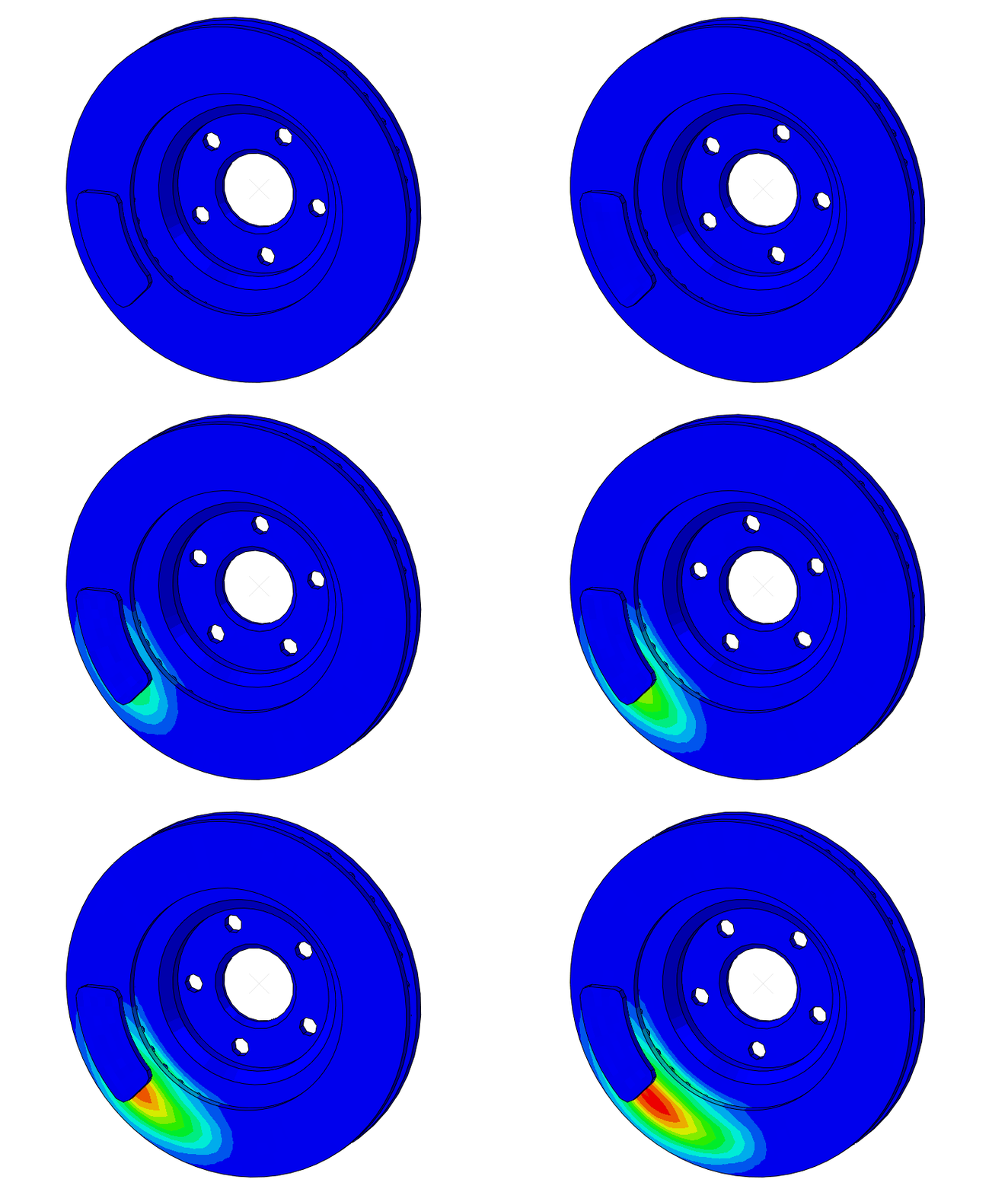
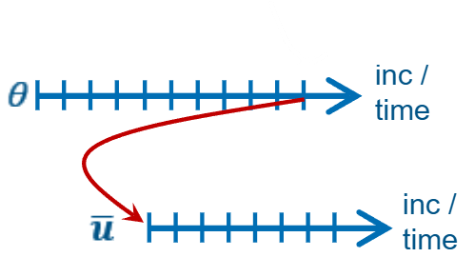
In practice, thermal-mechanical analyses are the most commonly used Multiphysics procedures. The most basic approach here is just mapping temperatures from the end of an independent heat transfer analysis as initial conditions for a structural model:
However, Abaqus also offers sequentially-coupled thermal stress analyses where temperatures from each increment of a heat transfer analysis are transferred to a structural analysis:
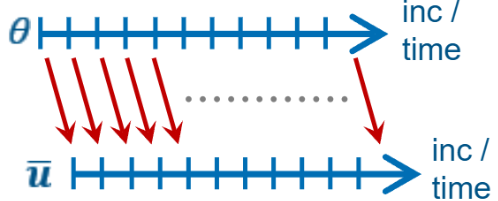
This is performed by first solving the pure heat transfer problem, then reading the temperature solution into a stress analysis as a predefined field. It is a one-way coupling only, but Abaqus has a special analysis procedure for full (two-way) coupling as well:
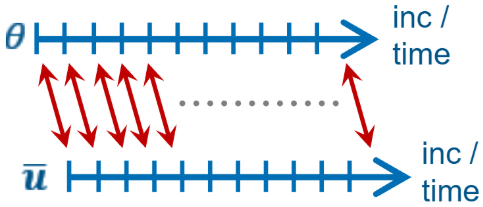
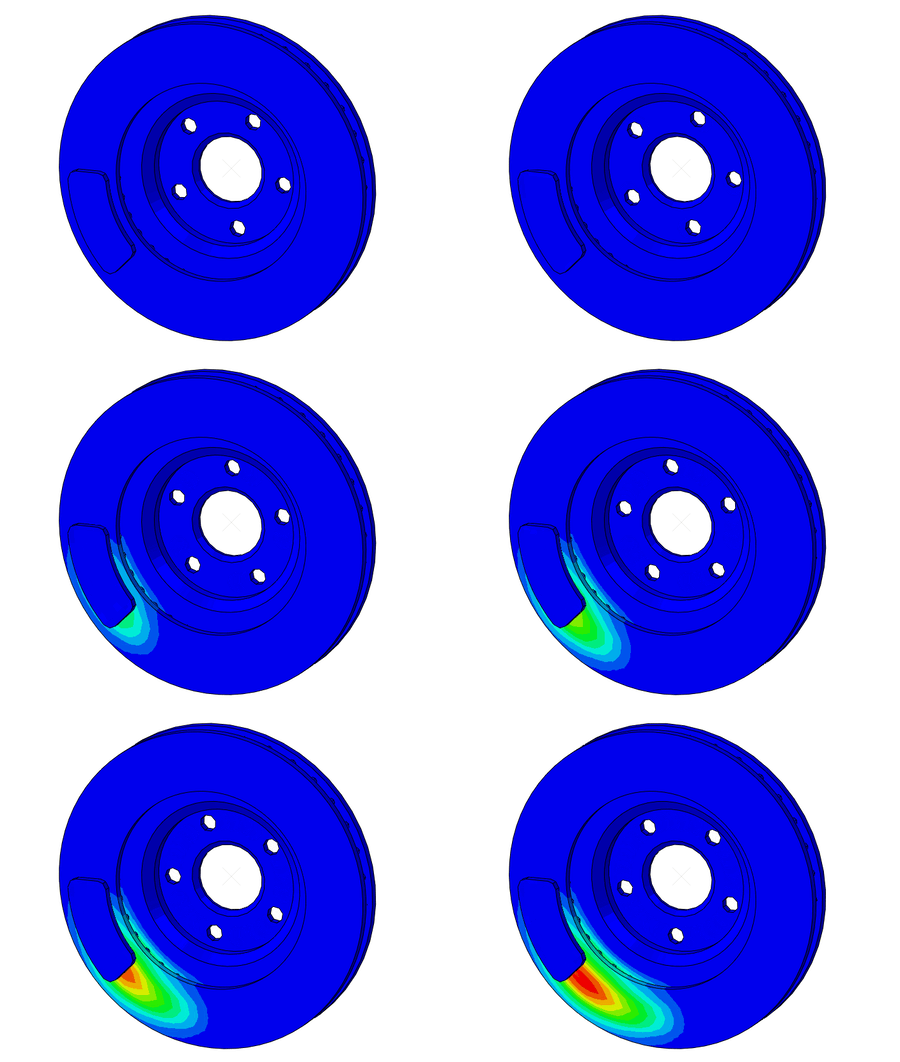
Then the stress analysis depends on the temperature field, but also the temperature field depends on the stress solution. Temperature and displacement are solved simultaneously with no need for separate runs. This way, it’s possible to account for heating due to inelastic deformation or friction.
Adiabatic analysis in Abaqus/Standard and Abaqus/Explicit can be used when plastic deformation causes heating, but it happens so quickly that there is no time for heat to diffuse through the material, so heat conduction can be ignored, and only local heating is modeled.
Thermal-electrical and thermal-electrical-structural analyses
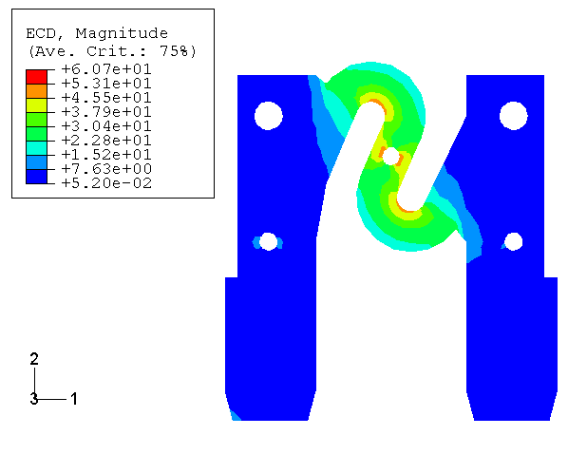
Abaqus/Standard includes a fully coupled thermal-electrical procedure where Joule heating can be modeled. Joule heating occurs when the energy dissipated by an electrical current flowing through a conductor gets converted into thermal energy. The coupled thermal-electrical equations are solved simultaneously for both temperature and electrical potential at the nodes. Coupling between the two fields is caused by temperature-dependent electrical conductivity/resistivity, and internal heat generation (which is a function of the electrical current density).
There is also a procedure that adds structural part to this problem so that a triple full coupling (thermal-electrical-structural) can be solved. All three fields (temperature, electrical potential and displacement) are then solved at the same time. Therefore, it’s a combination of the fully coupled thermal-stress analysis and coupled thermal-electrical analysis. Coupling between the temperature and displacement degrees of freedom is caused by temperature-dependent material properties, thermal expansion, and internal heat generation (which is a function of inelastic deformation). In addition, some problems involve contact conditions where the heat conducted between surfaces may depend on the separation of the surfaces and/or the pressure transmitted between them, as well as friction. Coupling between the electrical and displacement degrees of freedom occurs due to electricity flowing between contact surfaces. The electrical conduction may depend on the separation of the surfaces and/or the pressure transmitted between them. Additional coupling may occur due to piezoresistive effect (changes of electrical resistivity with stress). An example of a problem requiring a fully coupled thermal-electrical-structural analysis is resistance spot welding. In this process, thin metal sheets are pinched between two electrodes. A large current is passed between them, which melts the metal and forms a weld. Its integrity depends on the electrical conductance between the sheets (which can be a function of contact pressure and temperature), among others.
Coupled piezoelectric analyses
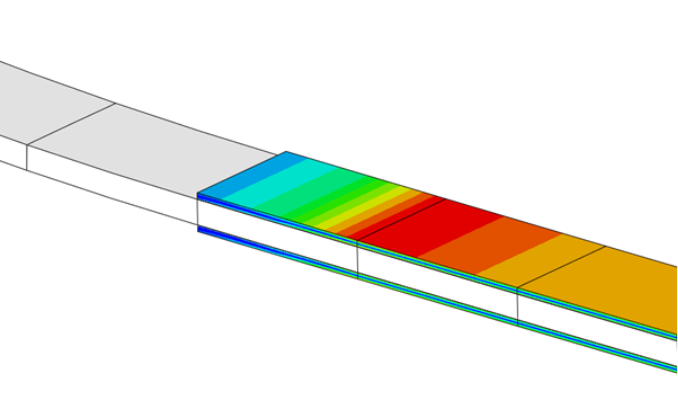
Coupled piezoelectric problems can be analyzed using static and dynamic analysis procedures in Abaqus/Standard. In these problems, an electric potential gradient causes strains, while stress causes an electric potential gradient in the material. Piezoelectric elements (with electric potential degree of freedom) and piezoelectric material properties have to be used.
Structural-acoustic analyses
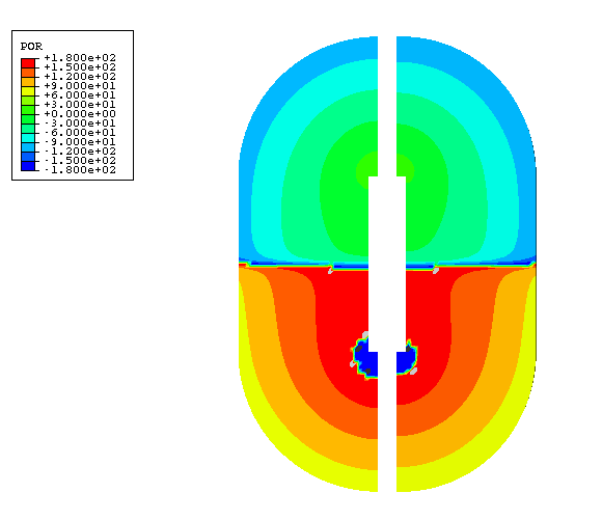
Coupled acoustic-structural analysis is not an individual procedure, but rather a general capability to include acoustic media (meshed with acoustic elements) in various dynamic structural analyses. Steady-state harmonic (linear) response analysis can be performed for a coupled acoustic-structural system, such as the study of the noise in a vehicle. Mode-based linear transient dynamic analysis is also available. The acoustic fluid elements can also be used with nonlinear dynamics (implicit or explicit direct integration) procedures. Often in coupled fluid-solid problems, the fluid forces in the linear range (small pressure changes in the fluid) are so high that the nonlinear response of the structure needs to be taken into account. For example, a submarine subjected to underwater incident wave loads due to an explosion may experience plastic deformation, or large motions of internal machinery may occur.
Thermal-electrochemical and thermal-electrochemical-structural analyses
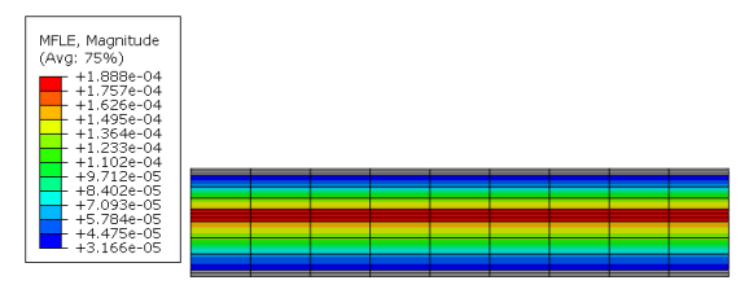
These procedures are relatively new in Abaqus – they have been introduced in the 2021 FD05 release. They can be used to analyze battery electrochemistry in order to assess the battery cell's capacity due to different loading conditions, thermal effects, and mechanical effects. Apart from porous electrodes, it is also possible to model solid electrodes in batteries, aging in lithium-ion batteries, and solid electrolyte and solid-state batteries. The coupled thermal-electrochemical procedure is meant for applications that require solving simultaneously for temperature, electric potential in the solid electrode, electric potential in the electrolyte, concentration of ions in the electrolyte, and concentration in the solid particles used in the electrodes.
In the fully coupled thermal-electrochemical-structural analysis, thermal and mechanical fields may affect each other. Moreover, the concentration in the solid particles used in the electrodes can affect the mechanical fields through eigenstrains caused by particle swelling during the charge/discharge cycle in the battery.
Finally, the fully coupled thermal-electrochemical-structural–pore pressure procedure adds pore fluid pressure that governs electrolyte flow. The fluid pressure and flow velocities in the electrolyte can be affected by the mechanical fields, gravity, and particle swelling during the charge/discharge cycle in the battery.
Coupled pore fluid diffusion and stress analysis
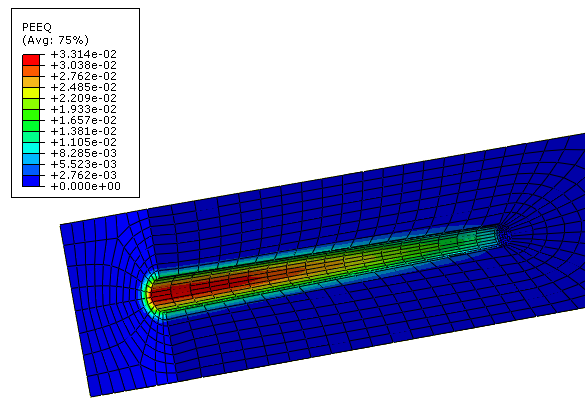
This procedure can be used to model single-phase, partially or fully saturated fluid flow through porous media and optionally also model heat transfer. A porous medium is modeled by considering the medium as a multiphase material and using an effective stress approach to describe its behavior. It considers the presence of two fluids in the medium. One is a so-called wetting liquid (relatively incompressible). The other is often a relatively compressible gas. An example of such a system can be soil containing ground water. When the medium is partially saturated, both fluids exist at a point. When it’s fully saturated, the voids are completely filled with the wetting liquid.
This procedure is meant primarily for geotechnical applications (soil mechanics), but can also be used in other areas, e.g. to model moisture migration. It might be steady-state or transient (consolidation) analysis.
Co-simulations
In addition to the aforementioned built-in multiphysics analysis procedures, Abaqus also supports co-simulations in which either two of its solvers are coupled or Abaqus is coupled with a third-party solver. The following workflows are supported via co-simulations:
- Fluid-Structure Interaction (FSI) - coupling Abaqus/Standard or Abaqus/Explicit to a Computational Fluid Dynamics (CFD) software. Abaqus solves the structural domain, and the CFD software solves the fluid domain. Abaqus can be coupled with the SIMULIA Navier-Stokes solver (available in the Fluid Scenario Creation app on the 3DEXPERIENCE platform) or with various third-party CFD solvers.
- Conjugate Heat Transfer (CHT) - conjugate heat transfer problems involving fluids and structures can be solved by coupling Abaqus/Standard to a CFD software. Abaqus/Standard models heat transfer within the solid, and the CFD software solves the energy equation for the fluid flow surrounding the structure. Abaqus/Standard can be coupled with the SIMULIA Navier-Stokes solver (available in the Fluid Scenario Creation app on the 3DEXPERIENCE platform) or various third-party CFD solvers.
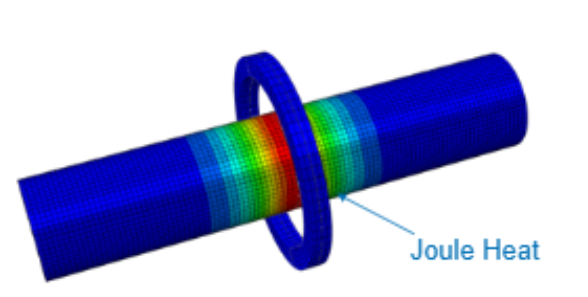
- Electromagnetic-thermal or electromagnetic-mechanical coupling - applications such as induction heating require interaction between electromagnetic and thermal fields. This can be achieved by coupling Abaqus/Standard with itself, where one analysis solves for the electromagnetic fields, while the other solves for the thermal fields. Alternatively, Abaqus/Standard can be coupled with CST Studio Suite or with various third-party electromagnetic solvers.
- System-level modeling via logical-physical interaction - modeling of systems that can include both physical (structural, thermal, acoustics, etc.) and logical components modeled via a Function Mock-up Unit (FMU) using the Functional Mock-up Interface (FMI).
CEL and SPH techniques
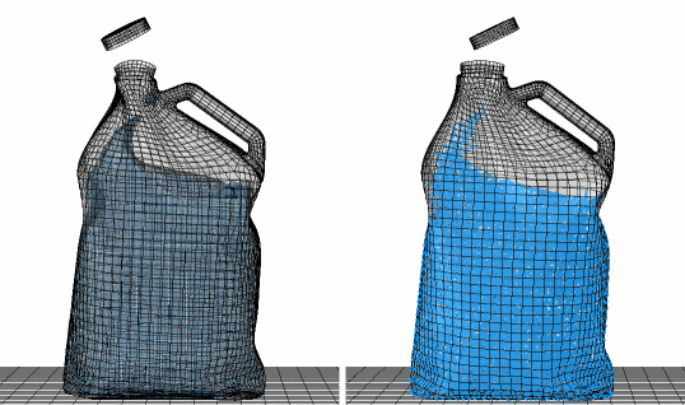
Even though Abaqus doesn’t have a CFD solver anymore (it was moved to the 3DEXPERIENCE platform in the 2017 release), co-simulations are actually not the only way to perform Fluid-Structure Interaction (FSI) analyses. Abaqus also offers two methods meant for fluid flow, FSI and large structural deformation problems – CEL (Coupled Eulerian-Lagrangian) and SPH (Smoothed Particle Hydrodynamics).
In an Eulerian analysis, mesh nodes are fixed in space, and material flows through elements that do not deform. Eulerian material can interact with Lagrangian elements through Eulerian-Lagrangian (general) contact, leading to CEL approach.
SPH is a Lagrangian approach involving the discretization of a continuum with a discrete set of points distributed over the solution domain without the need to define a spatial mesh. Bodies modeled with particles can interact with other finite element meshed bodies via general contact.
Summary
As discussed above, Abaqus offers not only a vast range of built-in multiphysics procedures involving thermal, mechanical, electromagnetic, electrochemical, acoustic and other domains, but also a co-simulation engine allowing advanced couplings between Abaqus solvers or between Abaqus and third-party solvers. Additional special-purpose modeling techniques are also available for large deformation problems, including fluid-structure interaction.
Together with the powerful nonlinear Abaqus/Standard and Abaqus/Explicit solvers, these functionalities form a comprehensive analysis framework capable of solving all kinds of practical and research problems. The reliability and robustness of these solutions have been tested over many years of Abaqus usage in engineering and academia. Thus, Abaqus can be considered a perfect choice for anyone interested in simulations of multiple physical phenomena interacting with each other.