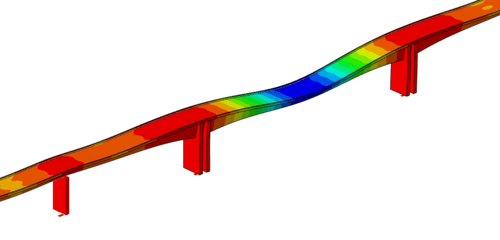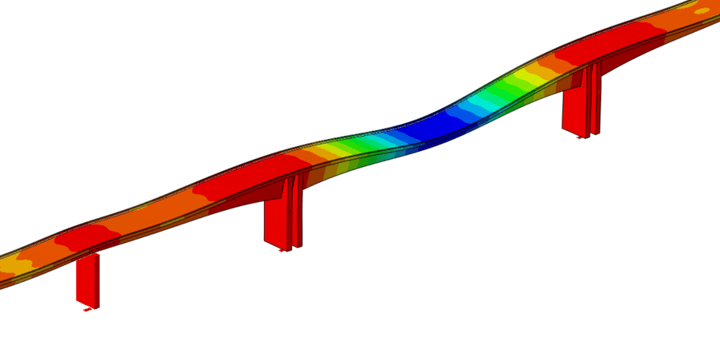
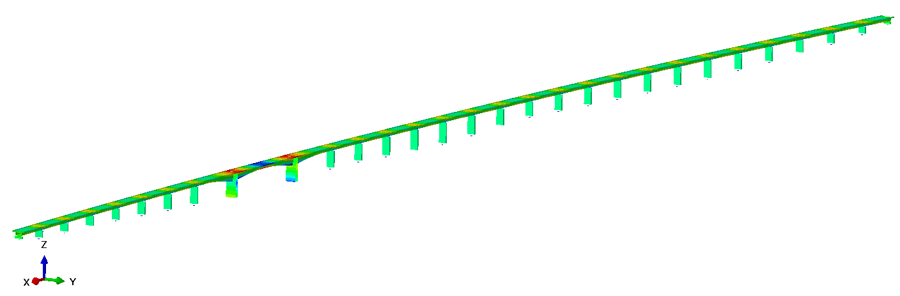
The bridge across the Nyköpingsån valley will be one of the longest railway bridges in Sweden. Inhouse Tech developed a finite-element shell model of the entire 1.4 km structure. Custom-developed scripts in BRIGADE/Plus automated model generation and ensured that design changes were incorporated consistently. They also structured the results for subsequent structural design and verification. The workflow reduced repetitive manual modelling, improved consistency and made full-bridge analysis practical at this scale.
During 2026, Inhouse Tech completed and delivered the detailed design documentation and structural analyses for the bridge in close collaboration with the Swedish Transport Administration, Trafikverket, the client for the East Link project (Ostlänken). TECHNIA provides BRIGADE/Plus, the structural analysis software used for the project. The new railway will cross the Nyköpingsån valley on a viaduct to reduce the impact on sensitive natural environments.
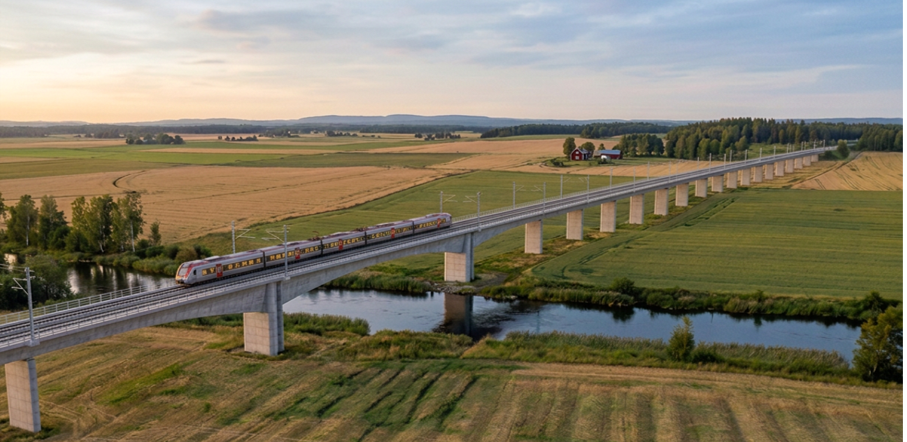
Rendering of the completed Nyköpingsån valley viaduct. Credit: Inhouse Tech.
Inhouse Tech selected BRIGADE/Plus for the structural analysis. The complete bridge was represented by a shell-element model, which the team used for traffic load, dynamic, staged-construction and track-bridge interaction analyses. Given the size and repetitive geometry of the structure, scripting became essential to the workflow.
| Total length | 1.4km |
| Typical span | 46m |
| Main span | 102m |
| Model | Shell-element-finite-element model |
| Analyses | Traffic-load, dynamic, staged-construction and track-bridge interaction analyses |
| Tools | BRIGADE/Plus, Python, and Excel |
| Client and project | Swedish Transport Administration (Trafikverket), East Link (Ostlänken) |
| Inhouse Tech's role | Detailed design documentation and structural analysis in close |
An unusual type of railway bridge in Sweden
A viaduct of this length is far from an everyday railway project in Sweden. Rather than crossing only the river itself, it carries the railway across the entire valley landscape. Traditionally, railway embankments have been the more common solution for long stretches over land in Sweden. The use of long viaducts as a more systematic alternative is less established and is now being further developed for Swedish conditions.
Inhouse Tech has been actively involved in this development. In a separate research and development project, the company worked on a viaduct concept for the Tjärnbäck Bridge on the North Bothnia Line, focusing on standardised, repetitive bridge sections.
Read more about that project here: Inhouse Tech in R&D project for the viaducts of the future.
The bridge across the Nyköpingsån valley has a different structural configuration from the bridge studied in the R&D project. Typical spans are 46 metres, the end spans are 36.8 metres, and the main span over the Nyköpingsån river is 102 metres, with adjacent side spans of 65 metres. The superstructure is supported on bearings at each pier, with expansion joints located only at the ends of the bridge.
For Inhouse Tech, the challenge was to create an analysis model capable of representing these conditions along the full length of the bridge while still being practical to work with throughout the design process.
Scripting made the full bridge model practical
Inhouse Tech has used BRIGADE/Plus since 2008 and has developed scripts for applications including parametric studies. See Structural Design Calculations at Inhouse Tech.
For the Nyköpingsån viaduct project, custom scripts generated the model in BRIGADE/Plus. Inhouse Tech also incorporated Excel into its scripting workflow to provide the team with a project-specific overview of inputs and analysis data.
According to Max Fredriksson at Inhouse Tech, scripting was essential for modelling the complete structure: ‘Without scripting, maintaining a consistent model of the complete 1.4 km structure would have required substantially more manual work.’
The team defined the bridge geometry, components and modelling rules in the input data, while the software generated the repetitive parts of the model. This avoided the need to create every component manually through the graphical user interface.
BRIGADE/Plus supports Python-based automation for model generation and results processing, enabling users to tailor workflows to their specific analysis needs.
Input-driven changes simplified model updates
The benefits of scripting became particularly clear when the design changed. Inhouse Tech could update the input data and regenerate the model instead of editing multiple locations manually.
For a bridge with many similar spans, this input-driven approach allowed each change to be defined once and applied consistently across all affected locations, reducing manual work and the risk of inconsistencies.
The scripts also created a well-organised model structure with clearly defined components. This made the analysis output easier to manage and simplified the extraction and processing of the results required for design verification.
Together, these capabilities connected model generation, controlled updates and results processing in a single workflow.
Traffic loading, static and dynamic response
Inhouse Tech carried out the traffic load analysis on the complete shell-element model. BRIGADE/Plus calculated the static response to moving railway loads using influence lines and influence surfaces. Because traffic lanes are defined independently of the finite-element mesh, the traffic load functionality could be applied directly to the detailed shell model. The team also used BRIGADE/Plus to generate load combinations in accordance with Eurocode.
Read more about how BRIGADE treats traffic loads and load combinations here: Traffic Loads and Load Combinations
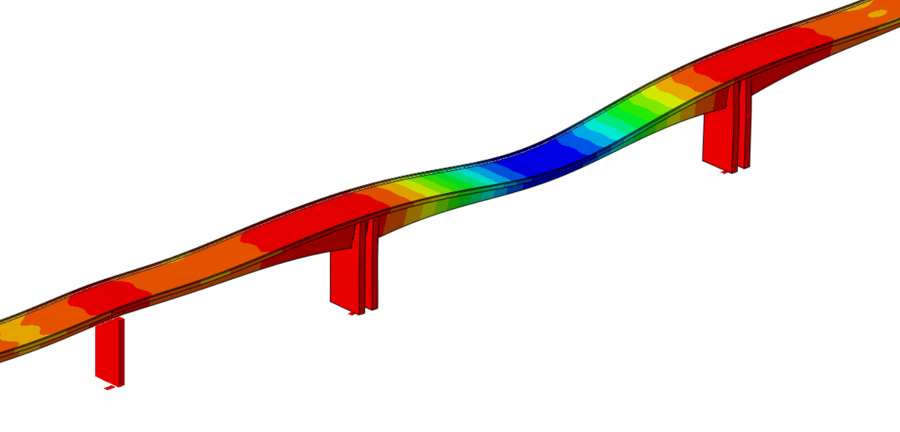
The dynamic response to high-speed train loading was analysed using modal time-history analysis. The High Speed Load Model (HSLM), as specified in Eurocode, was applied using the predefined implementation in BRIGADE/Plus. The analyses allowed Inhouse Tech to assess accelerations, displacements and potential resonance effects as high-speed trains cross the bridge.
Read more about dynamic analysis of bridges here: Best practices for dynamic analysis of bridges
Staged construction and track-bridge interaction (TBI)
Long-span concrete bridges are generally constructed in stages, which creates challenges during both structural analysis and construction. For this project, Inhouse Tech developed custom scripts for the staged-construction analyses. The Model change functionality enabled parts of the model to be activated progressively throughout the construction sequence.
This type of staged analysis makes it possible to follow how internal forces, stresses, deformations and support reactions develop as the structural system changes. It can also identify temporary governing conditions during construction and the redistribution of forces between previously constructed and newly activated parts of the bridge.
Track-bridge interaction (TBI) was also analysed in BRIGADE/Plus to assess how forces and movements are transferred between the continuously welded rails and the bridge. The analysis can be used to evaluate rail stresses, longitudinal deck movements and reactions resulting from temperature variations and train traction and braking forces. These effects are particularly relevant because the bridge expansion joints are located only at the ends and must accommodate bridge movements of ±500 mm.
Read more about TBI in TECHNIA’s article on Track-Bridge Interaction
Extended FBC linked shell-model detail to section-level design checks
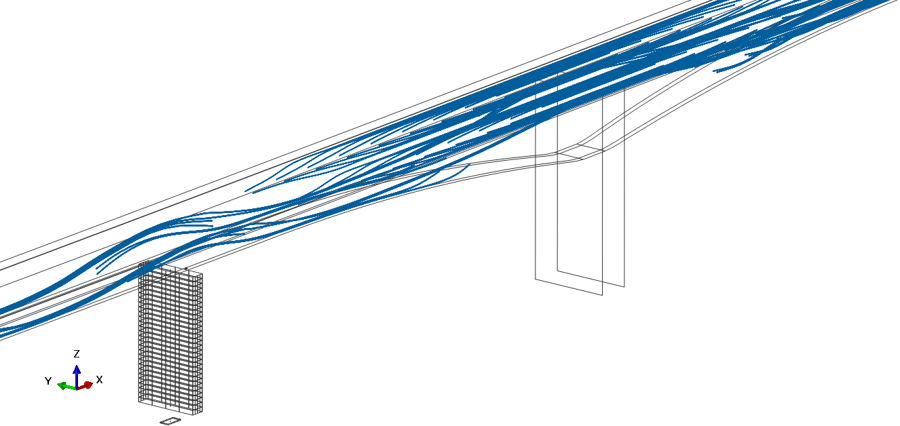
The team needed beam-like section resultants without giving up the detail of the shell model. Extended Free Body Cut (Extended FBC) in BRIGADE/Plus provided that link, allowing complete cross-sections to be evaluated for global verification and section design.
The cross-sections to be evaluated are defined during the modelling stage. BRIGADE/Plus then calculates the section resultants for each cut and load case, including axial force, shear force, bending moment and torsional moment. The results combine the load effects from all elements forming the cross-section.
Calculating the section resultants for each load case is particularly important in traffic load analysis. Individual shell elements within a cross-section may reach their extreme responses at different vehicle positions. Consequently, summing the independently calculated maxima for the individual elements does not produce a valid extreme section resultant. Extended FBC instead evaluates the combined section resultants for each relevant load position, providing results comparable to those obtained from a beam model.
Inhouse Tech exported the Extended FBC results for further verification outside BRIGADE/Plus. Tendon stresses, on the other hand, were evaluated directly in the software.
Read more about the Extended FBC functionality in TECHNIA’s article on TECHNIA’s article on Extended Free Body Cut.
Lessons for the next long viaduct
The full-bridge model also provided valuable insight into the analysis strategy. By showing that several similar bridge sections exhibited similar structural responses, it created a useful reference for identifying where future viaduct analyses potentially can be streamlined without losing essential structural behaviour.
This provides a practical basis for future projects: engineers can identify which parts of a bridge require individual analysis and where repetitive structural solutions support a more streamlined approach.
For the bridge across the Nyköpingsån valley, BRIGADE/Plus supported the complete workflow from model generation and analysis to results processing. Inhouse Tech’s scripts made model updates manageable, while the traffic load functionality, staged-construction analysis and Extended FBC produced the results required for the design work.
The scale is unusual, but the engineering tasks are familiar: build and update models, assess traffic loading, and carry results into structural design and verification. The Nyköpingsån viaduct project shows how Inhouse Tech combined scripting with BRIGADE/Plus to connect the workflow.
Working with repetitive bridge geometry, frequent design changes or large result sets? Contact the BRIGADE team at TECHNIA to discuss a scripted BRIGADE/Plus workflow for your project.