 Aerospace & defence
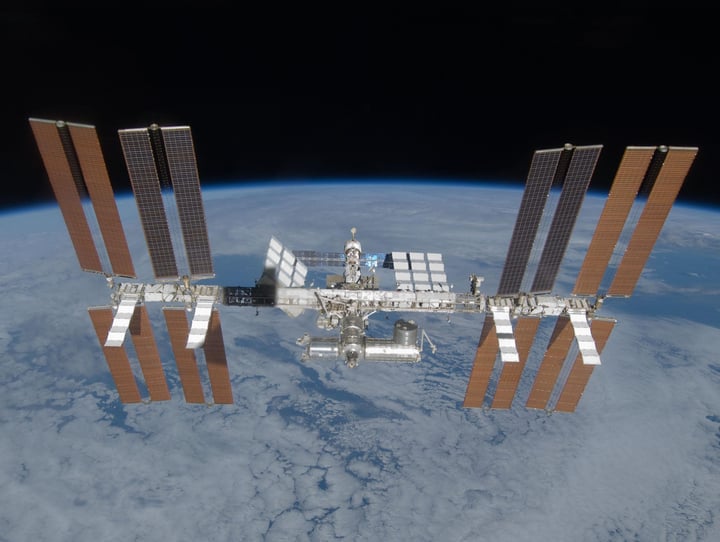
One of the most critical phases of any crewed space mission is the rendezvous manoeuvre. Following launch, spacecraft must accurately adjust their orbit to meet another vehicle travelling at approximately 7.7 km/s around Earth. The challenge becomes even greater when the target is the International Space Station (ISS), one of the largest and most complex structures ever placed into orbit.
This blog explores the orbital mechanics behind a Soyuz-ISS rendezvous, demonstrating how a Hohmann transfer can be used to transfer a Soyuz spacecraft from its initial parking orbit to the altitude of the International Space Station. The manoeuvre is modelled using a simplified simulation that highlights the key principles involved in orbital transfer operations.
From Launch to Orbit
The Soyuz launch system uses three rocket stages to deliver the spacecraft into low Earth orbit. As each stage completes its burn, the empty hardware is discarded to reduce vehicle mass and improve efficiency.
Following ascent, the spacecraft typically enters a parking orbit at approximately 220 km above Earth. From this initial orbit, a series of orbital manoeuvres are performed to gradually approach the International Space Station.
The simulation presented here focuses on the orbital transfer phase, using a classic Hohmann transfer orbit to move the spacecraft from its initial orbit to the ISS orbit.
Understanding Orbital Velocity
Before modelling the transfer, the orbital velocity of the spacecraft must be calculated.
This can be achieved by equating gravitational acceleration with the centripetal acceleration required to maintain a circular orbit.
Gravitational Acceleration
The gravitational acceleration experienced by an object in orbit is given by:
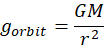
where:
 is the universal gravitational constant
 is the mass of the Earth
 is the distance from the centre of the Earth
This is commonly expressed using Earth's standard gravitational parameter,  :
:

Relationship to Orbital Velocity
For a stable circular orbit:

which can be rearranged to calculate orbital velocity:

This relationship provides the initial velocity required by the simulation for a spacecraft at a given orbital altitude.
Modelling the Soyuz Spacecraft
A simplified Soyuz spacecraft model was developed to demonstrate the rendezvous manoeuvre.
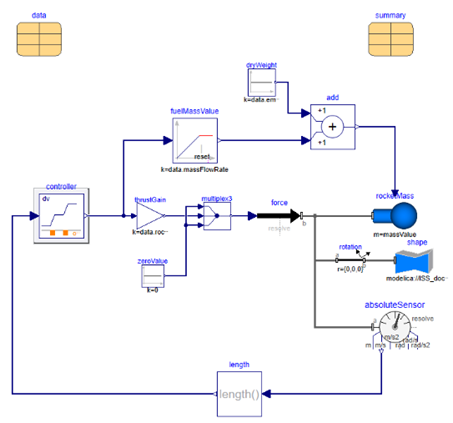
Figure 1. Simplified Soyuz spacecraft model with delta-V controller
The model includes a parameter record containing key spacecraft characteristics, such as:
- Dry mass
- Fuel amount
- Maximum thrust
- Propulsion system parameters
A simple control system manages the orbital burns and the controller activates the spacecraft thrusters at predefined points in the transfer and remains active until the desired delta-V has been achieved.
The control signal is used to:
- Apply thrust to the spacecraft
- Consume fuel
- Reduce vehicle mass accordingly
This provides a realistic representation of how spacecraft mass changes during manoeuvres and the impact this has on mission performance.
The world model (not visible in Figure 1) makes use of the PointGravity and the gravitational field constant is set to 
This approach provides an efficient and accurate representation of orbital motion while maintaining a relatively simple model structure.
Simulating the Hohmann Transfer
The simulation demonstrates a classic two-burn Hohmann transfer between the initial Soyuz parking orbit and the International Space Station orbit.
The animation below illustrates the orbital transfer sequence.
Model Assets
- ISS geometry obtained from NASA's 3D Resources Library: https://nasa3d.arc.nasa.gov/detail/iss
- Soyuz model by noelliespinelli, licensed under the Creative Commons Attribution licence
Conclusion
This simulation demonstrates the fundamental principles behind a Soyuz-ISS rendezvous manoeuvre using a Hohmann transfer orbit. The transfer is achieved through two carefully timed burns: the first raises the spacecraft to the ISS orbital altitude, while the second circularises the orbit to match the station's trajectory.
Although this simplified model captures the core orbital mechanics involved, real rendezvous missions are significantly more complex. Operational missions must account for orbital phasing, attitude control, navigation uncertainties, collision avoidance requirements, and a sequence of precision manoeuvres that enable safe docking with the International Space Station.
Nevertheless, the example illustrates how simulation can be used to explore orbital mechanics, validate guidance strategies, and improve understanding of spacecraft trajectory design, making it an effective educational tool for aerospace engineers and system modellers.