
 Advanced Simulation

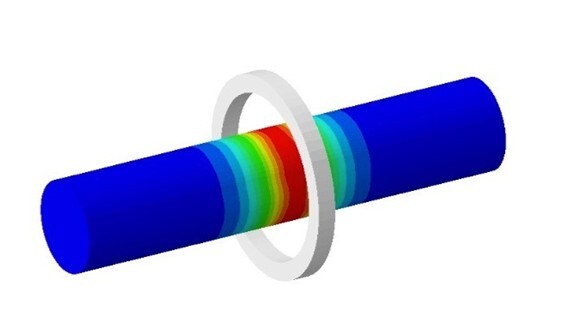
Although SIMULIA offers dedicated electromagnetic simulation software – CST Studio Suite – certain relatively straightforward analyses of this type can also be performed directly within Abaqus. The primary advantage of this approach is the ease of coupling the model with mechanical and heat transfer analyses. The available electromagnetic analysis types in Abaqus include:
-
Electrostatics – piezoelectric phenomenon,
-
Direct current conduction with Joule heating,
-
Magnetostatics,
-
Electromagnetics in the frequency domain,
-
Electromagnetics in the time domain.
Electrostatics
Electrostatics focuses on the analysis of static electric fields generated by stationary electric charges, based on Gauss's Law. In Abaqus, this scope is limited to piezoelectric analysis, where a change in electric potential induces strain, and mechanical stress induces a change in electric potential. These are coupled simulations performed using step types such as static, dynamic implicit, frequency, modal dynamic, or steady-state dynamics.
These analyses require the use of piezoelectric elements (where degree of freedom 9 represents electric potential) and specific material properties: linear elasticity and piezoelectric properties (*PIEZOELECTRIC) - defined by 18 stress or strain coefficients. These coefficients relate the electric displacement to stress/strain in a given direction. A definition of dielectric properties (*DIELECTRIC) is also required, which allows for electric charge to occur when an electric potential gradient is present. These properties are defined by the dielectric constant (or constants in the case of anisotropy) describing the relationship between the electric displacement and the electric potential gradient. Damping (including piezoelectric damping) can also be defined.
Boundary conditions, in addition to displacements, include the electric potential at nodes. Available loads include concentrated (point), surface, and body mechanical forces and electric charges. Output results related to the electric field include electrostatic energy density, electrical potential gradient vector, electrical flux (displacement) vector, and nodal electrical potential.
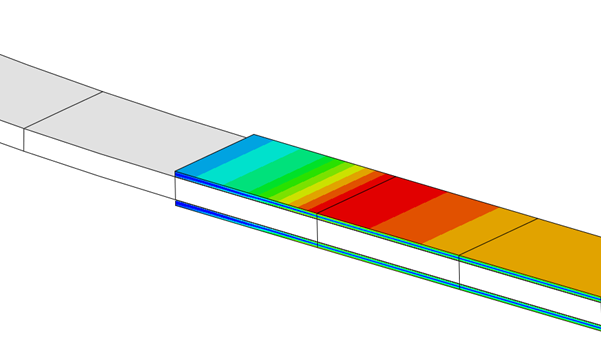
Example below – Piezoelectric transducer:
 DC conduction
Direct Current (DC) flow analyses are based on Ohm’s Law (i.e., the proportionality of current intensity to voltage) and can be performed in Abaqus using two types of coupled analysis steps:
-
*COUPLED THERMAL-ELECTRICAL – thermal-electrical coupling,
-
*COUPLED TEMPERATURE-DISPLACEMENT, ELECTRICAL – thermal-electrical-mechanical coupling.
The choice between steady-state and transient analysis only affects the thermal response; the electrical solution is always steady-state.
Elements with appropriate degrees of freedom are used: electric potential, temperature, and optionally displacement. Material properties must also cover these two or three physical phenomena. From an electrical standpoint, electrical conductivity or resistivity is required. The amount of thermal energy generated by the electric current is defined by the *JOULE HEAT FRACTION keyword.
Available electrical boundary conditions include nodal electric potential, while available electrical loads include concentrated current or current density (surface or body). Electrical solution results include the electrical potential gradient vector, electrical current density vector, and nodal electrical potential.
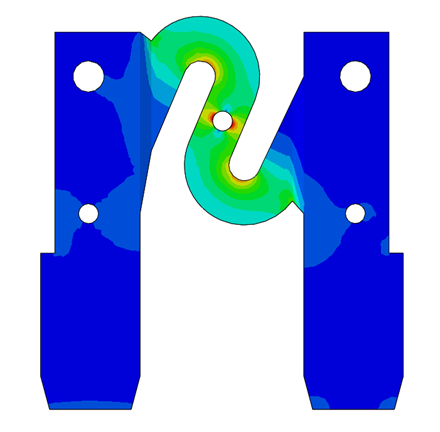
Example – Automotive fuse.
Magnetostatics
Magnetostatic analyses involve calculating static magnetic fields generated by direct currents or permanent magnets, based on Ampère’s Law. There is no electromagnetic coupling here; only the magnetic field itself is considered. There is a dedicated *MAGNETOSTATIC step for these simulations.
Electromagnetic elements are required. Magnetic permeability (*MAGNETIC PERMEABILITY) must be defined. Nonlinear magnetic behavior is supported through B-H constitutive curves. Permanent magnets can also be accounted for in this manner.
Boundary conditions in these analyses are not applied to nodes in the standard way due to an element edge-based field interpolation. Dirichlet boundary conditions in the form of magnetic vector potential are specified using the *D EM POTENTIAL keyword. Conversely, Neumann boundary conditions are loads in the form of surface current density vector. Body current density vector can also be defined. Output results include magnetic flux density vector and magnetic field vector.
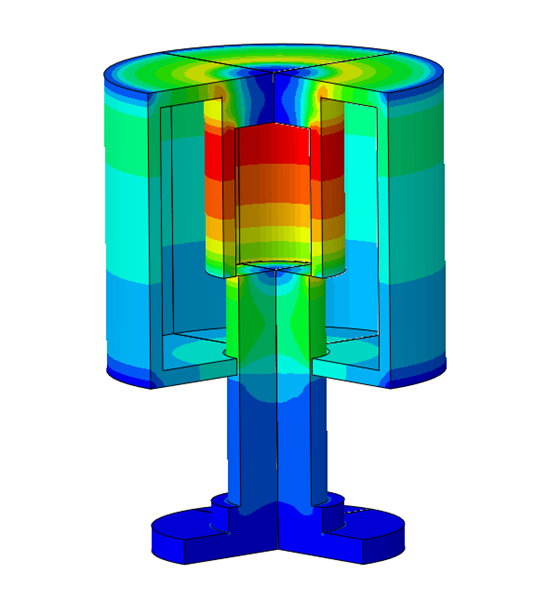
Example – Solenoid valve:
Electromagnetics in the frequency or time domain
Electromagnetic analyses in the frequency or time domain are referred to in Abaqus as Eddy Current analyses. They calculate induction currents appearing in conductors located in a varying magnetic field or moving relative to a static magnetic field source. The time-varying magnetic field can be specified via boundary conditions or generated by a coil placed close to the workpiece and modeled as air/vacuum. The coil carries a prescribed amount of total current alternating at a known frequency for a time-harmonic eddy current analysis or with an arbitrary variation in time for a transient eddy current analysis. These analyses account for the coupling between electric and magnetic fields, which are solved simultaneously. They are low-frequency electromagnetic analyses, meaning they neglect displacement current effects.
The *ELECTROMAGNETIC, LOW FREQUENCY keyword is used for these analyses. Selecting the TIME HARMONIC or TRANSIENT parameter determines whether the analysis is harmonic (analogous to steady-state dynamics in mechanical analysis - frequency domain response to harmonic excitation) or transient (time domain response). Notably, the Electromagnetic Time Harmonic step is the only electromagnetic procedure (aside from thermal-electrical and thermal-electrical-mechanical analyses) available directly in Abaqus/CAE (after creating an Electromagnetic-type model). Other step types must be defined using keywords. The Keyword Editor can facilitate this – it's sufficient to add electromagnetic time harmonic step, define analysis features based on it and manually change the step definition in the Keyword Editor.
Electromagnetic elements are necessary. Material properties always include magnetic permeability (nonlinear B-H curves and permanent magnets are supported in transient analyses). For conductors, electrical conductivity must also be defined.
The definition of boundary conditions and loads is analogous to magnetostatics. In harmonic analyses, boundary conditions and loads are specified as real and imaginary parts. In Eddy Current analyses, conductor motion can also be defined using the *MOTION keyword. Output results include magnetic flux density vector, magnetic field vector, electric field vector, eddy current density vector in conducting regions, magnetic body force intensity vector induced by current flow, and Joule heat generation rate.
Co-simulation between Abaqus solvers is also possible – linking an electromagnetic time harmonic or transient analysis with a mechanical or thermal analysis (e.g., induction heating).
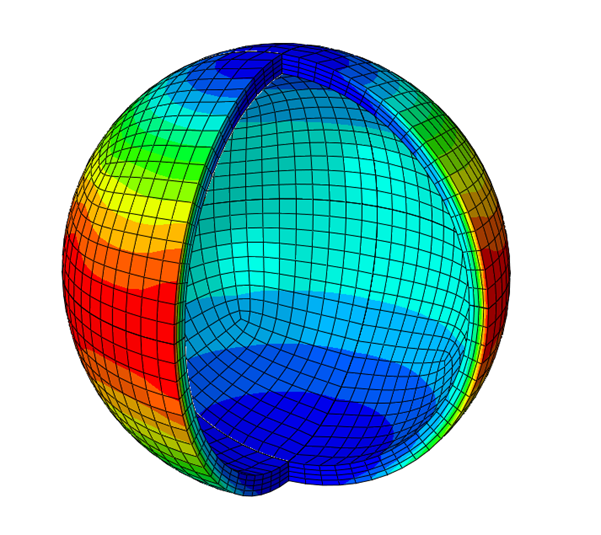
Example – Spherical shell in an external magnetic field:
.png?width=500&name=Blog-CAD%20Essentials-Smarter%20Tools%20for%20Faster,%20More%20Reliable%20CATIA%20Workflows%20(1).png)