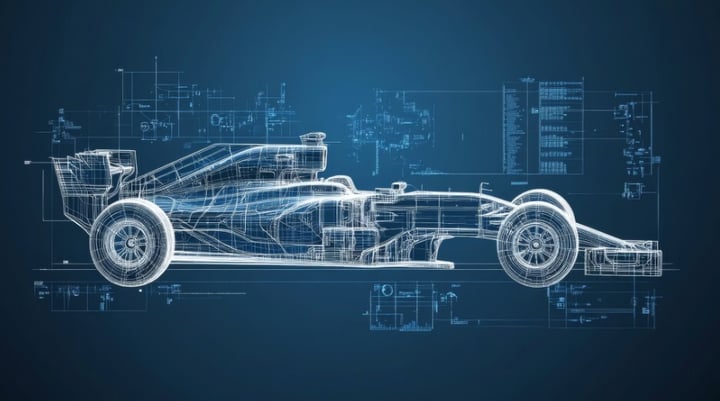
In a previous blog post, I talked about how the link between motorsport and automotive technology has evolved far beyond the old “win on Sunday, sell on Monday” mantra. Today, much of this connection can be described as technology transfer - not just of hardware, but of engineering tools, simulation methodologies and development processes.
Looking ahead, I don’t see this changing. When I look at how simulation in motorsport has grown to become a core engineering discipline, it’s clear just how much potential automotive simulation still has to transform road‑car development. Once simulation becomes essential, the genie never goes back into the bottle.
How simulation became vital in motorsport
Sporting competition tends to drive costs higher as revenues rise. But in motorsport, and especially Formula 1, the pressure to win makes that effect extreme. By the mid‑2000s - the peak of the big manufacturer era - F1 spending had reached an unsustainable level. As the 2008 financial crisis approached, the sport had to take action quickly, long before cost caps existed.
Almost overnight, physical on‑track testing was drastically restricted. The halcyon days of Michael Schumacher flying back to Fiorano during a race weekend for private overnight test sessions were gone. Teams needed a replacement for real‑world running, and they needed it fast.
Simulation becomes the lifeline
Vehicle simulation rapidly became the solution. Tools such as Dymola and the Modelica language gained popularity as teams realised they could recreate full‑vehicle behaviour virtually. Suddenly, engineers could replace huge amounts of track testing with virtual testing, run controlled experiments unaffected by weather, and interrogate specific subsystems in repeatable, isolated conditions.
Development cycles shortened. Decision‑making improved. And new workflows emerged that were simply impossible with physical testing alone.
This was the period when Claytex grew significantly, providing specialist Modelica, Dymola and system simulation expertise to teams adapting to the new era.
From optional tool to competitive advantage
Simulation and Driver‑in‑the‑Loop (DiL) simulators quickly became fundamental to performance engineering. Teams in NASCAR, IndyCar and other series soon adopted similar approaches, having seen how transformative motorsport simulation had become in F1.
And from that point on, simulation became a core pillar of modern racing engineering - a change that is now permanent.
From the racetrack to the road
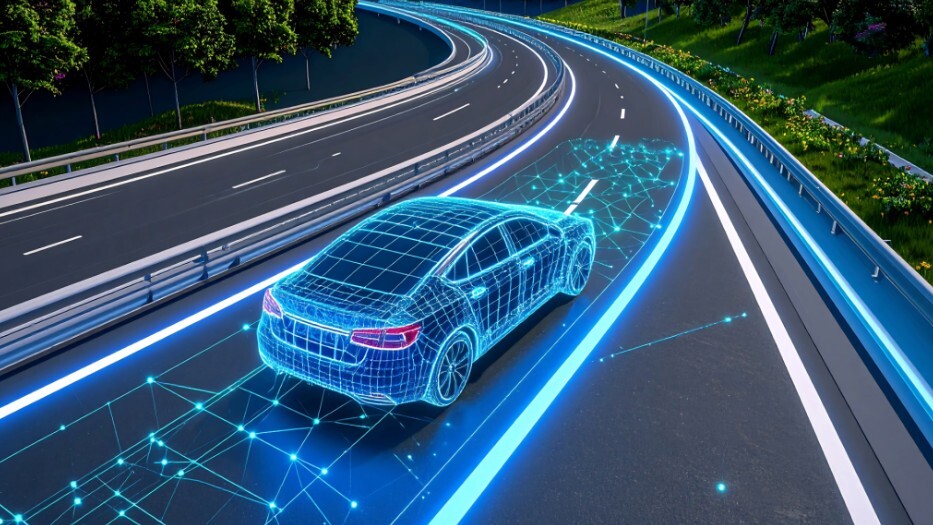
Automotive manufacturers have used simulation for decades, but the scale and sophistication of today’s automotive simulation programmes are on a completely different level. Unlike motorsport, there wasn’t a single “big bang” that forced adoption - instead, rising vehicle complexity and development pressures steadily pushed OEMs towards a more simulation‑driven approach.
Why road-car development needs advanced simulation
Developing a modern vehicle is incredibly challenging. Cars are expected to last 150,000+ miles, operate globally across extreme climates, and integrate mechanical, electrical and software systems seamlessly.
Traditionally, that means:
-
Fleets of expensive prototypes
-
Worldwide test campaigns
-
Large teams of support engineers
-
Parallelised test programmes to meet launch deadlines
It’s no surprise that OEMs increasingly turn to virtual durability testing, multi-domain vehicle modelling, and vehicle dynamics simulation to reduce the need for physical prototypes.
At Claytex, we’ve seen first-hand how implementing Dymola and Modelica based simulation programmes yields significant cost savings and accelerates development.
The development advantage
The benefit isn’t just cost reduction - it’s earlier insight. When engineers identify design shortcomings early using simulation, they avoid costly late fixes. More elegant solutions can be designed from the start, reducing waste and supporting the “Right First Time” philosophy most OEMs aspire to.
Simulation has quietly shifted from a supporting tool to a central component of automotive engineering.
Simulation as a core pillar of modern automotive engineering
We’ve all heard the terminology - MBSE, Virtual Twins, Digital Twins - and while each has its nuance, simulation sits at the heart of all of them.
Modern road cars are extremely complex mechatronic systems, combining mechanical systems, software, electronics, sensors and control algorithms. Traditional V-Model and waterfall processes can’t cope with the level of interdependency.
Simulation enables engineering teams to:
-
Iterate faster
-
Validate hardware and software together
-
Collaborate across domains
-
Understand system behaviour early
-
Reduce reliance on physical prototypes
The parallel with Formula 1 is obvious. If F1 teams rely on simulation to integrate dozens of interconnected systems, why wouldn’t OEMs do the same as their vehicles grow equally complex?
Future mobility, ADAS and autonomous vehicles
Everything I’ve discussed so far relates to conventional automotive development. But the future, electrification, ADAS and autonomous driving, amplifies the need for simulation even further.
Why autonomous vehicle development depends on simulation
ADAS and autonomous systems introduce challenges that are impossible to solve with physical testing alone:
-
Huge software complexity
-
Mechanical‑electronic‑software integration
-
Driver interaction modelling
-
Millions of required test miles
-
Rapid evolution of technology
-
High costs of physical prototypes
-
Regulatory constraints in various territories and ethical considerations
Physical testing alone simply cannot deliver the scale or repeatability required.
Autonomous vehicle simulation, sensor simulation, scenario generation, and virtual validation platforms become essential tools for OEMs and suppliers striving to meet safety and regulatory demands.
As the pace of technological change accelerates, simulation allows engineering processes to remain flexible, reactive and scalable.
Those that can, do… and those that learn, lead
Simulation is not going away. If anything, it’s becoming more tightly woven into the fabric of automotive engineering every year.
Training as a force multiplier
There are many ways to build simulation capability, but structured training is one of the fastest and most effective. At Claytex, we offer Dymola and Modelica training courses based on more than 25 years of experience in:
-
Multi‑domain physical modelling
-
Real‑time simulation
-
Model export and FMI
-
Vehicle dynamics simulation
-
Complex system modelling
Our courses, delivered online or in person, are modular, practical and designed to accelerate an engineering team’s ability to use simulation with confidence and impact.
Final Thoughts
From Formula 1 to high-volume road‑car development to the frontier of autonomous systems, simulation has become a strategic enabler. It reduces cost, accelerates timelines, improves quality and unlocks new engineering insights.
Motorsport proved what was possible.
The automotive industry embraced it.
And the future of mobility will rely on it more than ever.

 Advanced Simulation