 MBSE
MBSE
Component and system models can be defined once and then reused for different types of analysis. This is achieved by simply changing the boundary conditions that we impose on the model. Symbolic manipulation automatically rearranges the model equations.
The example below illustrates how a hybrid powertrain model can be reused to answer different questions by coupling different actuators to it:
How quickly will the vehicle accelerate with a given motor torque curve?
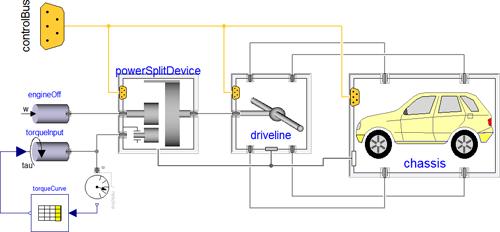
Here the boundary conditions are defined by a torque actuator that uses a torque curve based on engine speed to drive the system.
What torque is required to make the motor follow a set speed-time profile?
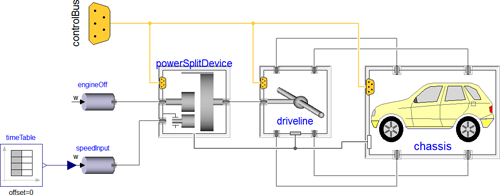
Here the boundary conditions are defined by a speed actuator that causes the electric motor to follow a specified speed-time profile
What torque is required at the motor to make the vehicle follow a set speed-time profile?
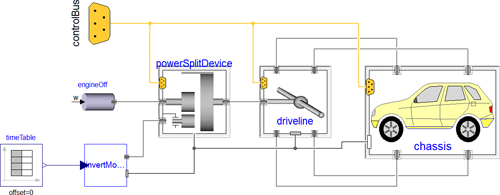
Here the boundary conditions are defined by an actuator that causes the vehicle body to follow a set speed time profile and it calculates the torque required at the motor to achieve this