 MBSE
MBSE

Do you really need detailed knowledge of every component in your system and how to model each component in order to successfully simulate the system? In this blog post I am going to consider this question, and how the existing Modelica libraries that Dymola supports affect the answer.
One thing I have come to recognise with experience, is that I cannot know everything about everything; even though the engineer in me is always curious to learn more. My knowledge includes a little about a lot of areas, and a greater depth of knowledge in a few areas. This is alright because I work in a team, which collectively has a much wider knowledge than my own. So as long as my team works together to share the knowledge, the outcome should be successful.
"Try to learn something about everything, and everything about something"
Thomas Henry Huxley
I think, this idea also applies when you are deciding how to approach simulation. To achieve your goal of successfully simulating your system, you probably do not actually need to know everything about your system and how to model it. Because someone may have already figured out how to model it, and you can leverage that in your work. Dymola supports an existing ecosystem of Modelica libraries, covering a vast range of domains and applications that you can use to supplement your inhouse knowledge.

Modelica and Dymola support collaboration
Dymola uses the Modelica language. Together, Dymola and Modelica support us in sharing our knowledge by:
- Being object oriented - We use objects that represent the physical components that we put together to create more complex systems. It encourages hierarchical modelling, where we can reuse models and easily interchange components in a plug-and-play style.
- Being multi-domain (multi-physics) - We are not limited to creating one type of system. There are existing Modelica libraries in mechanical, electrical, electronic, magnetic, hydraulic, thermal, control domains plus many others.
- Being open - You can see the code defining the majority of models in Modelica libraries. So you can understand how they work. This code can also be customised if required.
- Supporting FMI (Functional Mock-up Interface) - This lets you import models from other tools into Dymola, or export Dymola models for use in other tools.
- Allowing interfaces with external tools - There are examples where interfaces exist to permit Dymola to work with other tools.
Idea into practice
We have done a lot of modelling and simulation in the automotive industry here at Claytex. Cars are complex systems, covering a wider range of domains. While our libraries cover many of the vehicle subsystems, we recognise the benefits that can be gained by using third party Modelica libraries to complete the remaining vehicle subsystems.
This is illustrated in our VehicleDemos library, where the Claytex VeSyMA suite and FluidPower libraries are combined with libraries from other developers.
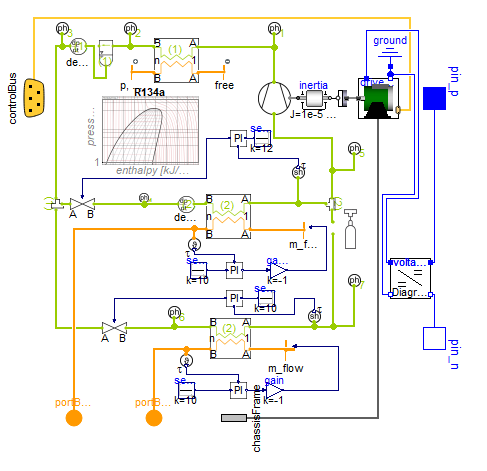
In the VehicleDemos electric bus example, we wanted to investigate the effect of the heating, ventilation and air conditioning (HVAC) systems on the bus's battery performance. We used the ThermalSystems and TSMobileAC libraries from TLK.
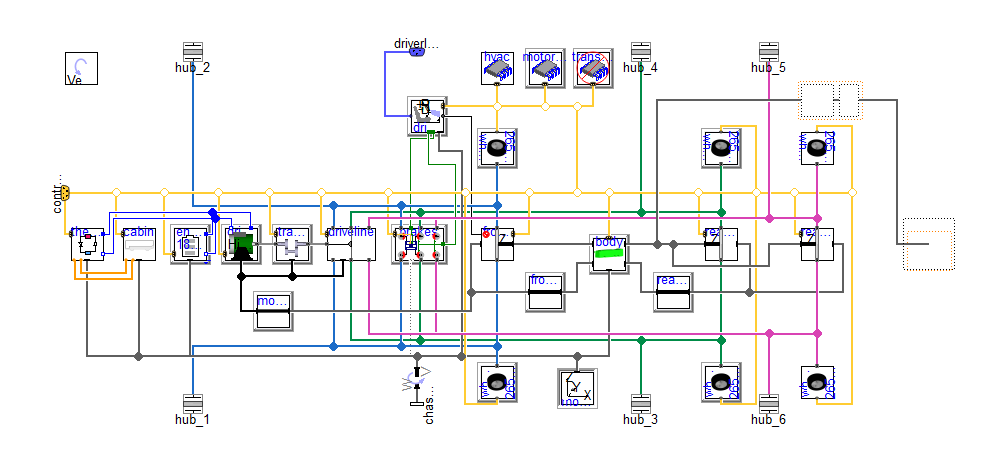
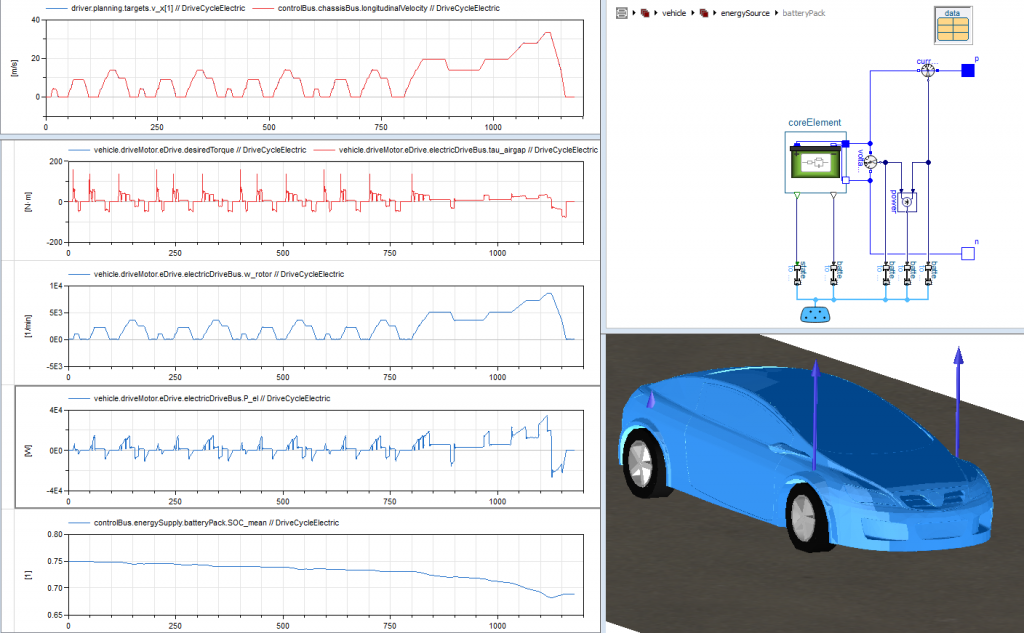
To create an electrified car with a higher fidelity electrified powertrain, we used the ElectrifiedPowertrains library (EPTL).
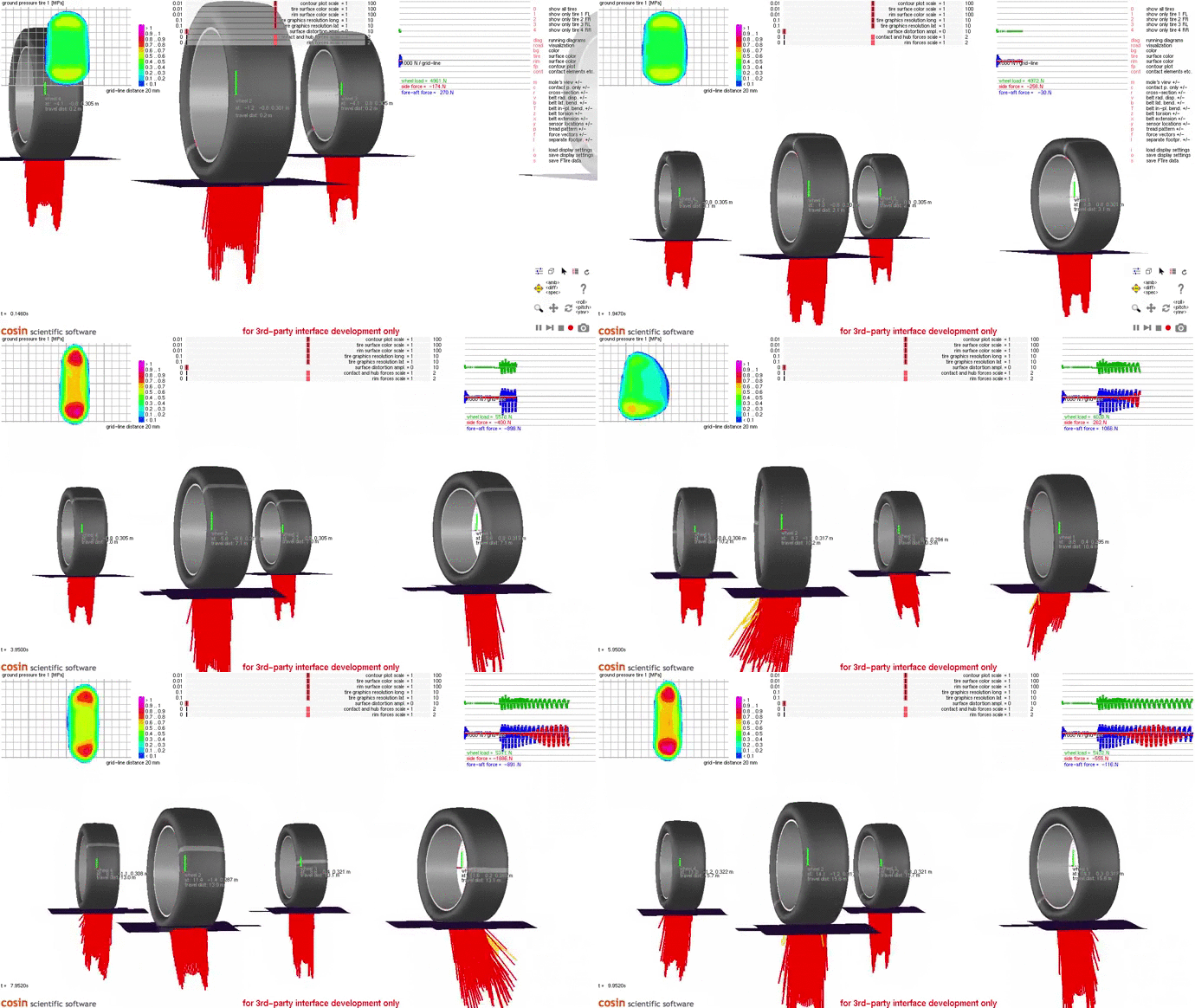
In addition, we have extended capabilities by interfacing with specialist tools such as:
Some things to consider
- Library structure - Use hierarchical structures based on interfaces and templates.
- Understand the results - You still need a good understanding of the system and its behaviour.
- What goes in, comes out - A simulation is only as realistic as the data used.
- End of life - Ensure libraries are maintained and compatible with newer Dymola versions.
Don't be an island
By treating our Modelica library as an island entire of itself, we miss the opportunity to expand our modelling capability by using the wider Modelica library community surrounding Dymola.
Please take a look at the collection of libraries we can supply and support here to see which can help you accomplish your simulation goals.
Written by: Hannah Hammond-Scott - Modelica Project Leader