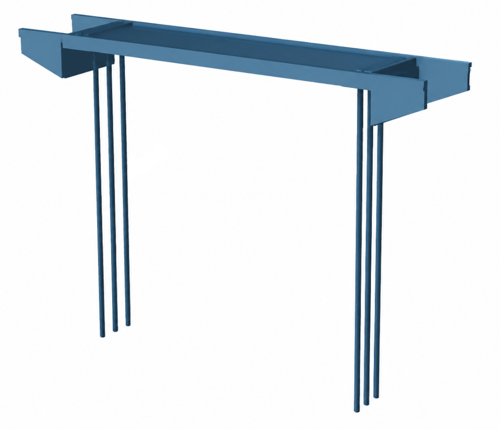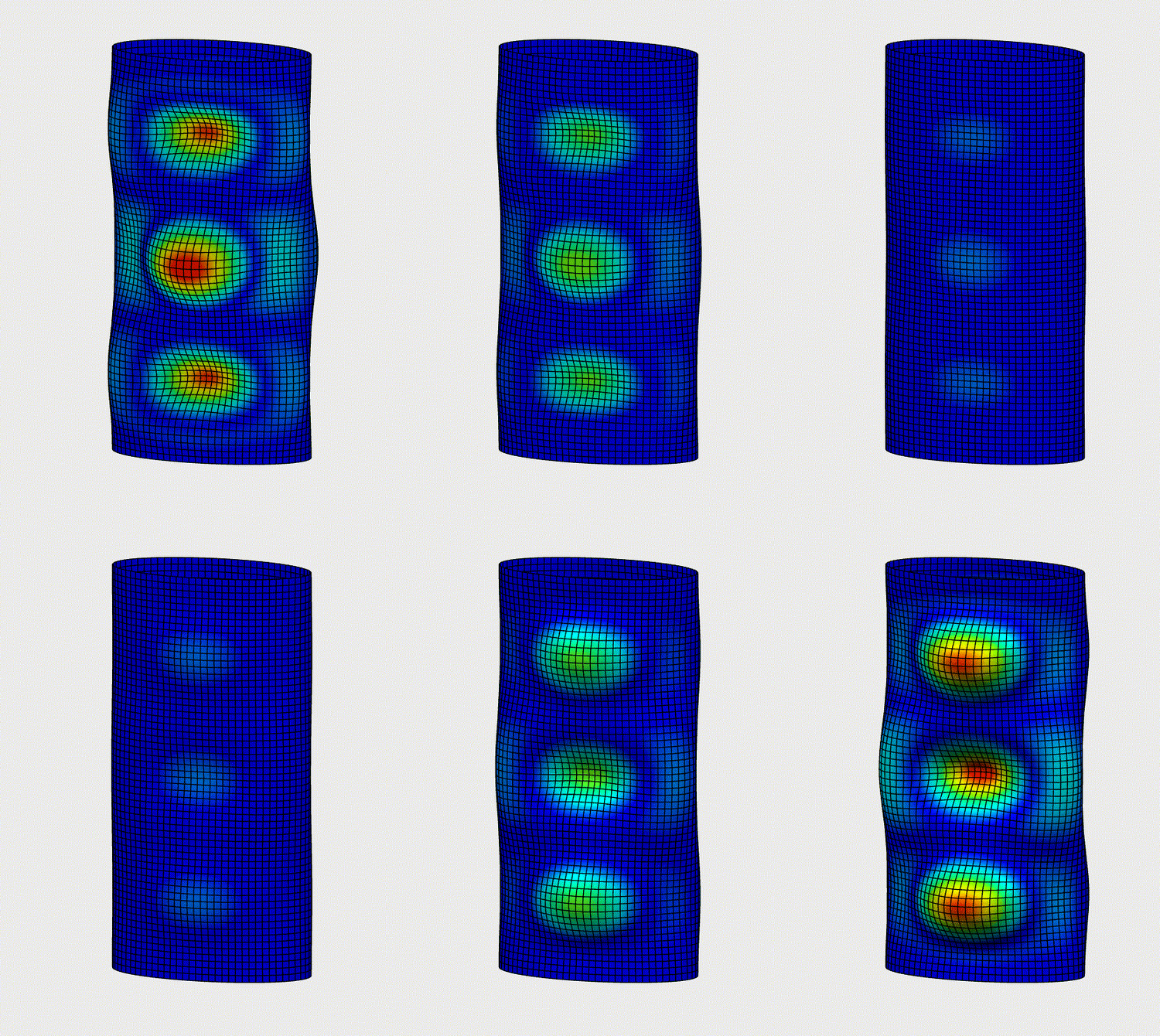
A bridge pile can be simple to calculate when it is treated as an isolated member. Define the axial load, assume a boundary condition at the pile head, represent the surrounding soil in a simplified way and check the member against the chosen stability model.
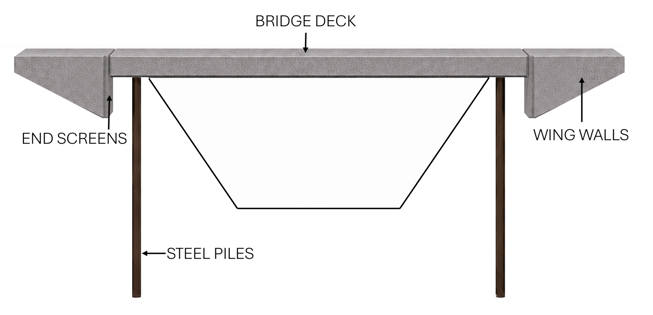
But an integral abutment bridge does not contain isolated piles.
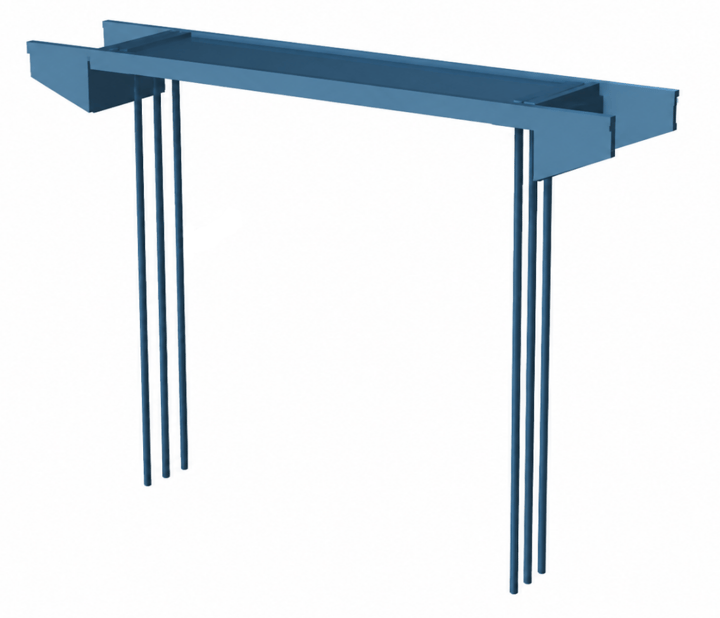
The pile is connected to the abutment. The abutment is connected to the deck. The surrounding soil restrains lateral movement. Thermal deformation and transverse actions can change the bending state, while the bridge system can redistribute forces as stiffness changes and plasticity develops.
This raises an important modelling question: when does the usual isolated-pile idealisation stop representing the mechanism that governs capacity?
That question was investigated by Sofie Almar and Lydia Binbach in their 2026 Master's thesis at the Division of Structural Engineering, Chalmers University of Technology.
Using BRIGADE/Plus, the authors developed finite element models that moved step by step from simplified single-pile representations toward piles interacting with the surrounding soil and the complete bridge system.
The result is a useful case study in a broader principle of structural analysis: boundary conditions are not bookkeeping. They are part of the structural model.
Conceptual sketch
Why the free pile-head assumption matters
Simplified pile checks often use a free or weakly restrained pile head. This can be a reasonable and transparent basis for design, especially when the engineer wants a conservative member-level check.
The problem with that approach is that an integral bridge provides restraint through the abutment and deck. If that restraint stabilises the pile, a free-head model may predict a lower axial capacity than the system can actually develop. In the end, that can lead to oversized pile dimensions and inefficient use of materials.
For a conventional conservative check, the simplification may be entirely acceptable. But if the engineer is investigating ultimate behaviour, global buckling or the real distribution of internal forces, the simplification can obscure the mechanism that the analysis is meant to capture.
Almar and Binbach therefore compared different modelling levels rather than adopting one boundary condition as a fixed truth.
Add one physical mechanism at a time
The study considered two soil conditions and found substantial differences in behaviour. Piles surrounded by friction soil developed higher axial capacity than piles in soft clay in the analysed cases.
That outcome is intuitive at a high level: stronger lateral restraint stabilises the pile. But the modelling significance goes further. Changing soil stiffness affects the deformation shape of the pile, the bending moments generated along its length and the interaction between pile and superstructure. In an integrated system it can also change how forces are redistributed between members.
This is why soil-structure interaction should not automatically be reduced to a question of whether a spring is "stiff" or "soft". The relevant question is what mechanism the spring or soil representation is intended to reproduce and how sensitive the structural response is to that representation.
For practical modelling, that suggests testing a plausible range of soil stiffnesses rather than treating one input value as exact when the geotechnical uncertainty is significant.
Restraint from the bridge system can increase pile capacity
One of the central findings was that piles integrated into the bridge system generally showed higher capacity than the corresponding isolated-pile models.
The thesis attributes this to redistribution of internal forces and the sequential formation of plastic hinges. The surrounding structure provides restraint and alternative load paths as the pile response evolves.
This is an important distinction between member analysis and system analysis. An isolated model asks, in effect: how does this pile behave under prescribed end conditions? The integrated model asks: how does the pile behave while connected to a structure that can attract, redistribute and restrain forces?
Neither question is universally more correct. They answer different design questions.
For a conservative member check, the isolated model can be useful. For understanding the nonlinear capacity of an integral bridge, the system model can reveal stabilising mechanisms that the isolated model cannot represent.
Model boundaries deserve the same attention as material models
Advanced analysis discussions often focus on constitutive models: nonlinear steel, concrete plasticity, contact or soil behaviour. Those choices are important, but this thesis shows that boundary conditions can be equally influential.
A perfectly sophisticated pile material model cannot recover restraint that was removed by the idealisation at the pile head. Likewise, detailed soil behaviour may have limited value if the connection to the bridge system is represented inconsistently with the structural question.
For bridge engineers, a useful model-review checklist is therefore:
- Which degrees of freedom are restrained at the pile head, and why?
- Which parts of the bridge provide that restraint in reality?
- How is lateral soil support represented, and over what depth?
- Which soil properties are uncertain enough to require sensitivity studies?
- Are transverse actions and imposed movements relevant to the initial bending state?
- Is the purpose a conservative member check or a system-capacity assessment?
- Has the simplified model been verified before nonlinear system behaviour is introduced?
Why BRIGADE/Plus fits this type of investigation
The study used BRIGADE/Plus to build and compare the different finite element representations. The value of the environment in this context is the ability to keep the bridge structure, pile representations, boundary conditions and nonlinear analyses within one model-development workflow while changing the assumptions deliberately.
The software itself does not decide which pile-head restraint is correct. That remains an engineering judgement. What the FE environment provides is a practical way to test the consequences of competing assumptions against a verified baseline.
This distinction matters. Advanced analysis is most useful when it supports a question the engineer has formulated clearly, rather than when complexity is introduced simply because the software allows it.
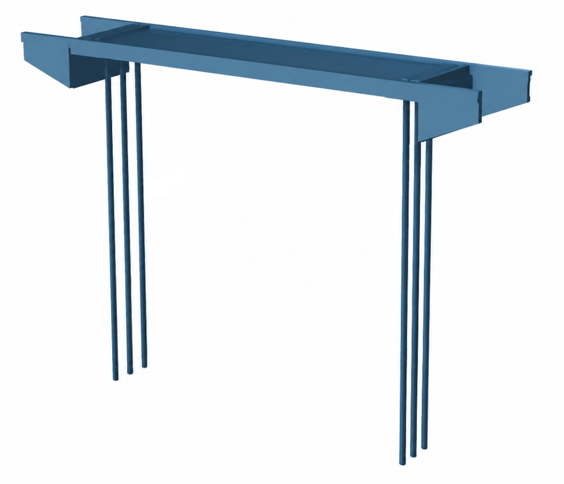
Bridge system
From isolated component to structural system
The broader lesson from Almar and Binbach's thesis is applicable well beyond integral abutment bridges.
Structural engineers routinely extract components from larger systems so they can be designed efficiently: a pile, a bearing, a connection, a cross-beam or a slab strip. The resulting boundary conditions are necessary abstractions.
Problems arise when the component-level boundary conditions are carried into a situation where system interaction is itself the phenomenon of interest.
A useful strategy is therefore to maintain both levels:
- Use the component model for transparency, hand-checking and conservative screening.
- Use a system model when redistribution, restraint or interaction may significantly affect the governing mechanism.
- Compare the two to understand what the simplification removes.
- Carry the simpler method forward where its conservatism and limits are understood.
That approach preserves the value of simple engineering models without asking them to answer questions they were never designed for.
About the study
Impact of pile head restraint and soil stiffness on the response of steel piles for integral abutment bridges was written by Sofie Almar and Lydia Binbach in 2026 at the Division of Structural Engineering, Chalmers University of Technology, within the Master's programme Structural Engineering and Building Technology. It was carried out with Samuel Wiik and Max Fredriksson at Inhouse Tech AB as Supervisors,
The complete thesis is available through the Chalmers ODR repository.

Want to investigate soil-structure interaction in a bridge model?
BRIGADE/Plus supports general FE modelling and nonlinear analysis for bridge and civil structures, allowing engineers to investigate how alternative restraints, interaction assumptions and structural-system representations affect the response.
Talk to our BRIGADE experts to discuss an analysis strategy for your project.